Spiritism is a philosophical doctrine that proposes understanding reality through the continuous accumulation of knowledge, seen as the basis of individual progress. Systematized by Allan Kardec from 1857 onward, it rests on a principle the Codifier himself made explicit: when doctrine and science diverge, science should prevail.
This site exists to present, rigorously and impartially, the foundational works of this doctrine — the Spiritist Codification — as a starting point for those who wish to study it. The knowledge gathered here is not intended to validate or refute; it is meant to provide direct access to the sources and their historical context, so that each reader can form their own understanding.
More than a library, this project is born from the conviction that personal growth — intellectual and moral — is what, over time, naturally generates the willingness and capacity to contribute to the good of others.
The Foundational Works
Spiritist Doctrine was systematized by Allan Kardec, pseudonym of Hippolyte Léon Denizard Rivail, in five books published between 1857 and 1868, known as the Spiritist Codification or Kardecian Pentateuch.
The Spirits Book (1857)

Published on 18 April 1857 in Paris, "The Spirits Book" is the first of the five books that make up the Spiritist Codification, compiled by Allan Kardec, pseudonym of Hippolyte Léon Denizard Rivail. The definitive 1860 edition gathers 1,019 questions posed by the Codifier, with answers obtained through several mediums in different countries.
The work is organized into four parts: First Causes, dealing with the origin of the universe and of spirits; the Spirit World, on its nature and relationship with humans; Moral Laws, which systematizes the ethical principles of the doctrine; and Hopes and Consolations, on the afterlife.
Within the Codification, this is considered the foundational book — the basis on which Kardec's subsequent works were developed, expanding on themes introduced here. Spiritists themselves commonly point to it as the natural entry point for studying the doctrine, since it presents its principles in a structured way before moving on to the following works.
The Mediums' Book (1861)

Published in Paris on 15 January 1861, "The Mediums' Book" (subtitled "A Guide for Mediums and Invocators") is the second book of the Spiritist Codification. Kardec presents it as a continuation of "The Spirits Book": while the first deals with the philosophical side of the doctrine, this one addresses its experimental side.
The work explains the theory behind different types of Spiritist manifestations, the means of communication with what Kardec called the "invisible world", and the development of mediumistic ability, which he describes as latent, to varying degrees, in everyone. It also discusses the practical difficulties that may arise when studying these phenomena.
Within the Codification, this book represents the methodological side of Spiritism: it starts from the observation of phenomena — such as the "turning tables" popular in mid-19th-century Europe — to build what Kardec described as "a treatise grounded in scientific research and experience". It is generally recommended for those already familiar with the principles of "The Spirits Book" who wish to explore the practical side of the doctrine.
The Gospel According to Spiritism (1864)
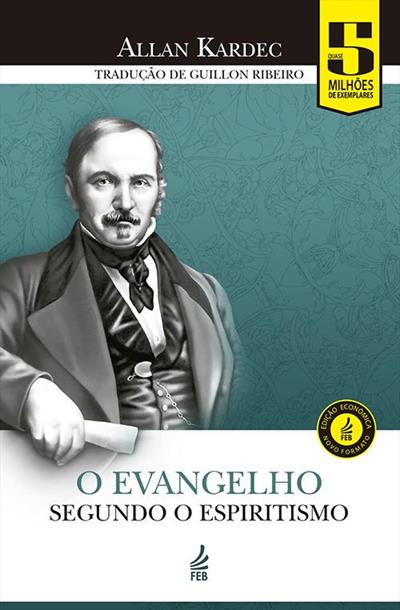
Published in Paris on 15 April 1864, "The Gospel According to Spiritism" is the third book of the Spiritist Codification. Its first edition was published under the title "Imitation of the Gospel", later replaced, from the second edition onward, by its definitive title; the structure now associated with the work was established in the third edition, in 1866.
The book is organized into 28 chapters, each centered on a passage from the canonical gospels, followed by commentary and by "Instructions from the Spirits" obtained mediumistically. Topics include faith, charity, reincarnation, and the principles of Christian morality, interpreted from a Spiritist perspective. The work closes with a collection of prayers.
While "The Spirits Book" establishes the philosophical foundations and "The Mediums' Book" the experimental side, this third book completes the set with its moral pillar: applying the doctrine's principles to personal conduct. Spiritists describe it as a central reference for inner reform — the process of individual moral improvement proposed by the doctrine.
Heaven and Hell (1865)

Published in Paris on 1 August 1865, "Heaven and Hell" — originally titled "Divine Justice According to Spiritism" — is the fourth book of the Spiritist Codification. Its central theme is divine justice: what happens to the spirit after death, and to what extent that condition results from one's own actions during life.
The work is divided into two parts. The first, "Doctrine", offers a comparative examination of different religious views on the afterlife, discussing concepts such as angels, demons, eternal punishment, and purgatory, and presents the Spiritist position on these themes. The second part, "Examples", gathers accounts attributed to spirits in different conditions — described as "happy", "suffering", or "in atonement" — regarding their experience after death.
Within the Codification, this book expands on a theme already introduced in "The Spirits Book": the idea that a spirit's condition in the "spirit world" is presented as a consequence of its own actions, rather than a verdict imposed by an external authority.
Genesis (1868)
Published in Paris on 6 January 1868, "Genesis, the Miracles and the Predictions According to Spiritism" — usually referred to simply as "Genesis" — is the fifth and final book of the Spiritist Codification. Several of its ideas had previously been discussed in the Spiritist Review, a publication Kardec edited between 1858 and 1869.
The work is divided into three parts. The first analyzes the origin of the Earth and the universe from three perspectives — organic, spiritual, and biblical ("Mosaic") — seeking a rational reading that avoids supernatural explanations. The second part addresses the so-called "miracles" described in the gospels, proposing explanations based on natural laws not yet fully understood by the science of the time. The third deals with predictions about the future of humanity.
This is the work in which Kardec most explicitly develops the scientific dimension of the doctrine, often considered his most mature within the Codification. The book reaffirms a position present throughout Kardec's work: that science and Spiritism "complete one another" — without one, the doctrine lacks proof; without the other, science lacks an explanation for certain phenomena.
Posthumous Works (1890)

"Posthumous Works" was published in Paris in January 1890, organized by the Parisian Society of Spiritist Studies under the direction of Pierre-Gaëtan Leymarie, more than twenty years after the death of Allan Kardec in 1869.
The book opens with a biography of Kardec and the speech given at his funeral by astronomer Camille Flammarion. It then presents a compilation of texts in two parts: articles written by Kardec but not published during his lifetime — either for lack of time or because they no longer reflected his most recent thinking — and records of mediumistic communications from sessions in which Kardec took part.
It is worth noting that this work is not part of the Spiritist Codification itself (the five books above, known as the Pentateuch). Rather, it is a historical document on the thought and journey of the Codifier, compiled after his death from material he had not organized for publication himself.
Beyond the five books of the Codification, there is also "Posthumous Works", published in 1890 from writings by Kardec not published during his lifetime. It is not part of the Codification, but is often associated with it as a complementary work — hence being referred to as the "5+1".